If you’ve been keeping an eye on the ACCA horizon, you’ll know that the landscape is about to shift. We’ve had the current Performance Management (PM) syllabus for a good while now, but come September 2027, things are changing. Out goes PM, and in comes E5: Performance with Data Analysis.
I know what you’re thinking. “Richard, I’m just trying to get through my next sitting: do I really need to worry about 2027?”
The short answer? Yes, but not because you should wait. Quite the opposite. If you can sit PM now, you should crack on. Nobody should be delaying their studies for a future exam change. I’ve spent 30 years in the exam trenches, we’ve seen syllabus changes come and go, but the shift from PM to E5 is more than just a name change. It’s a fundamental pivot in what the ACCA expects from a modern management accountant.
Let’s break down exactly what’s happening, what’s staying the same, and whether the "new" exam is actually harder.
The Core: What’s Staying the Same?
Before we panic, let’s look at the bedrock. The fundamentals of Performance Management aren't going anywhere.
The core syllabus areas remain largely intact:
- Costing Techniques: You’ll still need to understand Activity-Based Costing (ABC), Target Costing, and Life Cycle Costing.
- Decision-Making: Relevant costs, CVP analysis, and limiting factor analysis remain vital.
- Budgeting and Control: The mechanics of variances and budget types aren't leaving us.
- Performance Measurement: You’ll still be looking at the Balanced Scorecard and financial/non-financial performance indicators.
Think of these as the "classic" hits. They are the essential tools every accountant needs.

The Big Shift: It’s All About the Data
The most significant change is right there in the title: Performance with Data Analysis.
In the current PM syllabus, we touch on information systems and types of data, but it often feels like a theoretical footnote compared to the "heavy" maths of variances or transfer pricing. In E5, data is no longer a footnote; it’s the headline act.
The new syllabus places a massive emphasis on:
- Data Needs and Sources: Understanding where data comes from (big data, external vs. internal) and how to ensure its quality.
- Data Collection and Preparation: This is very technical. It's about how we handle data before we even start the analysis.
- Data Interpretation: Moving beyond "the variance is $500 adverse" to "what does the data tell us about our future strategy?"
In the modern business world, we aren't starving for information; we're drowning in it. The ACCA wants to ensure that when you walk into a boardroom, you aren't just the person who calculated the numbers: you’re the person who can interpret the "noise" of data into actionable insights. This makes E5 more technical and, frankly, more aligned with what high-level employers are looking for right now.

Sustainability: Not Just a Buzzword
Another major addition to E5 is a dedicated focus on Sustainability.
While the current PM syllabus mentions environmental accounting, it’s often a small part of the "Performance Measurement and Control" section. In E5, this is ramped up significantly. You’ll be expected to understand environmental costing techniques and how sustainability impacts the long-term performance of an organisation.
This reflects the global shift toward ESG (Environmental, Social, and Governance) reporting. Performance management is no longer just about profit; it’s about "Profit, People, and Planet." If you're someone who cares about the bigger picture, you might find this part of E5 fascinating. However, from an exam perspective, it adds another layer of qualitative analysis that you need to master.
Funnily enough I have anticipated this change in several of my PM in the PM Podcast, including this one published a month ago https://youtu.be/LAPwVuVyp48

The "Step-Up": Bridging the Gap
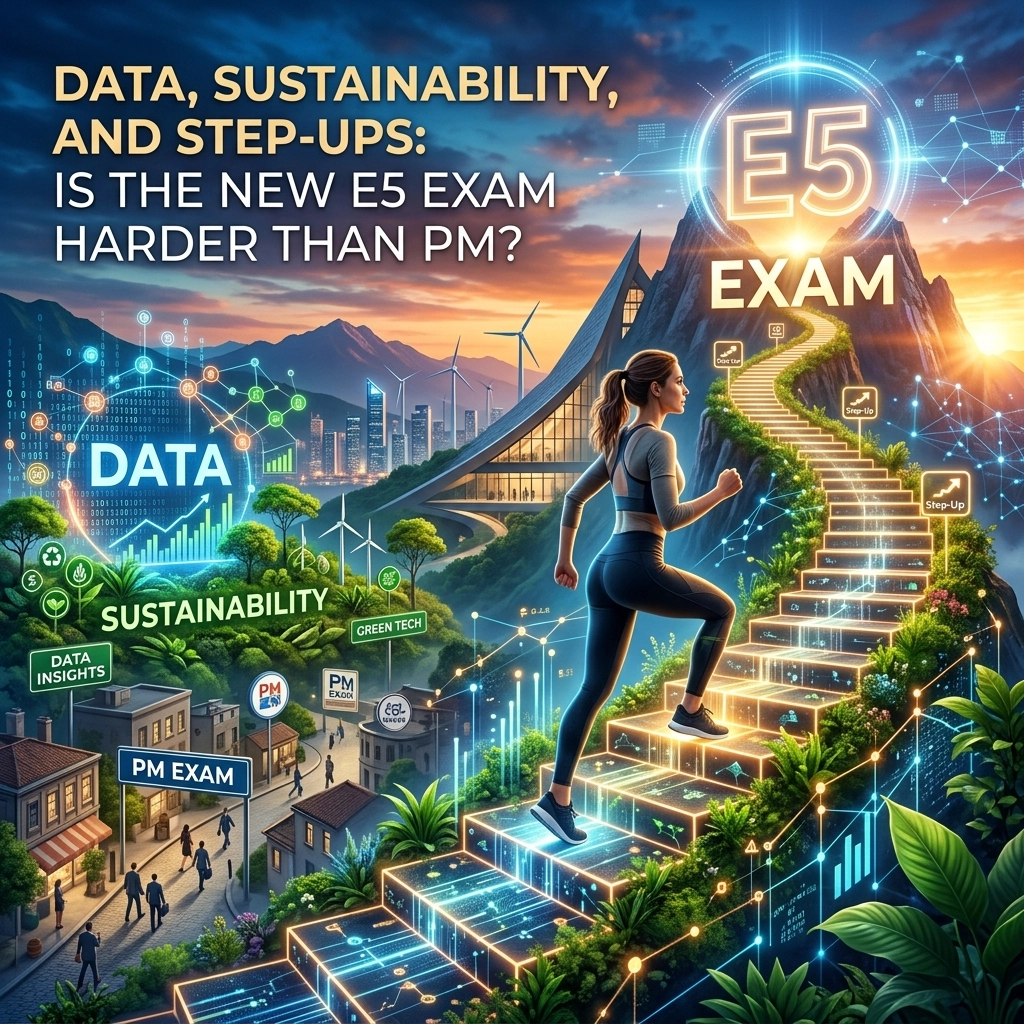
Here is the kicker. The ACCA has explicitly stated that E5 is designed to be a "significant step up" from the old PM.
Why? Because it is meant to create a stronger bridge from Applied Skills to Strategic Professional. E5 is there to give students a better foundation for:
- SBL (Strategic Business Leader), where performance, data, judgement and business context all come together.
- SPI (Strategic Performance and Insights Professional), which replaces APM and pushes much harder on strategic analysis and interpretation.
- SDS (Strategic Data Science Professional), a new paper that builds naturally on the data side of E5.
So this is not just a rebrand. It is ACCA trying to make the move to Strategic Professional feel less like a leap in the dark.
E5 is designed to bridge that gap. It acts as a closer Step-Up to the professional level. This means:
- More complex scenarios.
- A higher requirement for discursive, evaluative answers.
- Less "plugging numbers into a formula" and more "explaining the strategic impact of those numbers."
In terms of format, the exam stays the same: 3 hours, Sections A, B, and C. But don’t let that fool you. The depth of the questions in Section C is likely to be much more demanding than what we see in the current PM format.

Is E5 Harder Than PM?
Let’s be real. "Harder" is subjective, but if we look at the facts, E5 is certainly more complex.
- PM is about mastering the mechanics of performance management. It’s tough, but it’s structured.
- E5 is about mastering the mechanics plus the data science plus the sustainability integration plus higher-level strategic analysis.
If you are a tech-savvy student who loves data and wants to work in sustainability, you might find E5 more engaging. But for the average student just trying to get their letters, E5 represents a broader syllabus with more "moving parts" to get wrong.
My Advice: Don’t Wait
If you are currently eligible to sit PM, my strongest advice is to sit it now.
Don’t wait for the 2027 change. Don’t pause your studies. Don’t tell yourself you’ll just deal with E5 later. There is no upside in delaying for a future syllabus. Passing PM now gives you the foundation you need without the added technical burden of the E5 data modules.
If you pass PM, you are exempt from E5.
Once you have PM under your belt, you’ve secured that credit. You won't have to go back and "upgrade" to E5 later. You can keep moving toward your qualification and tackle the advanced stuff when you're actually at the Strategic Professional level.
How to Handle PM (and Prepare for E5)
Whether you’re rushing to beat the 2027 deadline or you eventually find yourself sitting E5, the secret to success remains the same: Expert guidance and practice.
The reason I managed to score 97% wasn't because I'm a maths genius: it was because I understood the "why" behind the numbers. That’s what I teach in my courses.
If you're worried about the step-up in difficulty, we’ve seen these shifts before, and we know exactly how to guide you through them. We focus on the exam technique that scores marks, regardless of whether the topic is a "classic" variance or a modern "data analytics" question.
Final Thoughts
The change to E5 is a positive move for the profession. It makes the ACCA qualification even more relevant to the 21st-century business environment. But for you, the student, it represents a steeper hill to climb.
The clock is ticking toward September 2027. Use this time wisely. Get your PM pass in the bag, move forward with confidence, and let us handle the heavy lifting of keeping up with the syllabus changes.
Ready to knock PM out of the park before the rules change? Let’s get to work.