Let’s be honest: balancing a full-time job with the ACCA Performance Management (PM) exam feels a bit like trying to plate-spin while riding a unicycle. You’ve got deadlines at work, family commitments, perhaps a social life that’s currently on life support, and then there’s the small matter of mastering things like throughput accounting and variance analysis.
If you’re feeling the pressure, I want you to take a deep breath. You are not alone. In fact, most of the students I work with on PM are in exactly the same boat. And more importantly, it is absolutely possible to sail that boat to a pass.
I didn’t study ACCA in a vacuum. I was right there in the trenches myself. I passed every single one of my ACCA exams first time while working a demanding full-time role. I know the exhaustion of a Tuesday evening when you’d rather be watching Netflix but have to tackle CVP analysis instead. I know the "Sunday Scaries" when you realise you haven’t opened a textbook all weekend.
This guide is built on my real-world experience. It’s not about "finding more time", it’s about making the time you do have work harder for you.

The Reality Check: What Does It Actually Take?
Before we get into the "how," we need to talk about the "how much."
One of the biggest reasons students fail PM isn’t a lack of intelligence; it’s a lack of realistic planning. ACCA PM is a beast. It’s considered the toughest Applied Skills exams because it requires a shift from "calculating things" and "knowing things" to "explaining what those calculations and knowledge actually mean for a business."
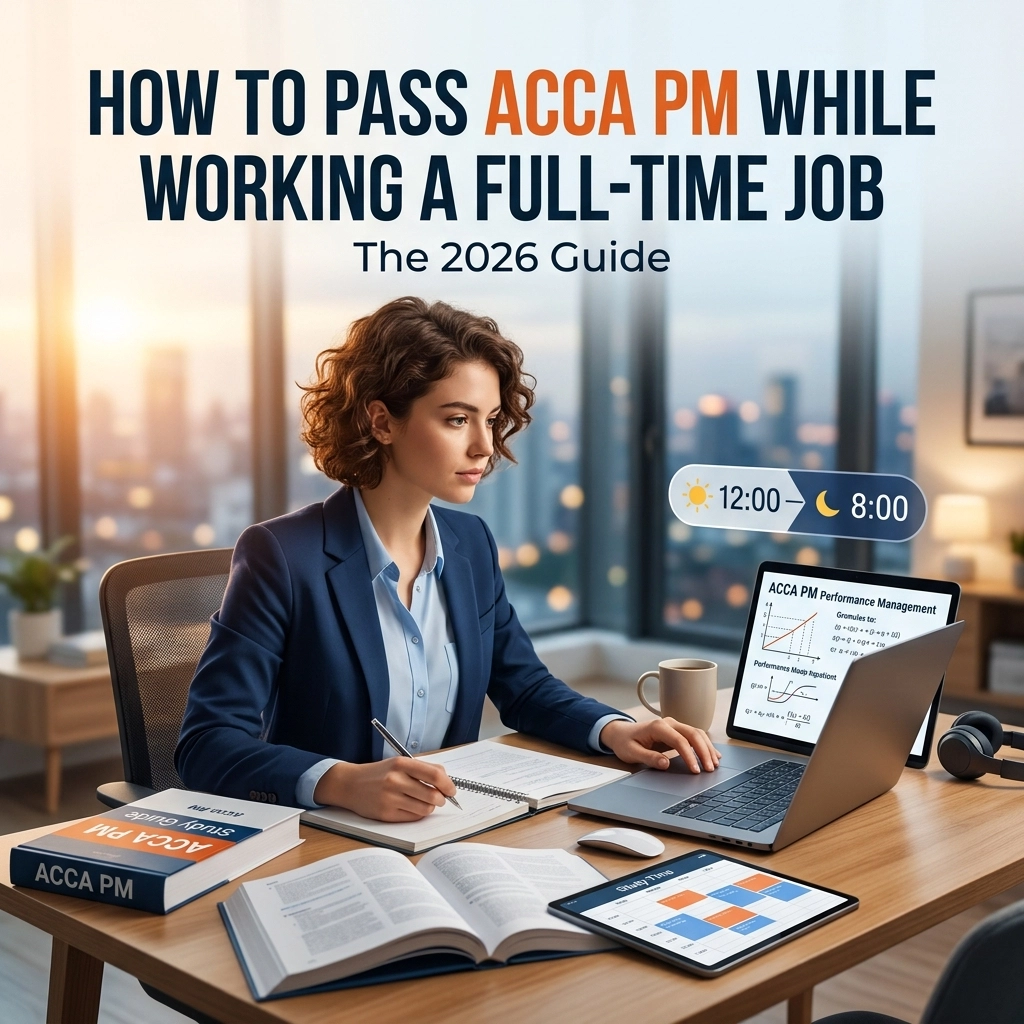
For a working professional, you should be looking at a commitment of 12 to 14 hours per week during the early stages of your tuition. As we get closer to the exam, that number will naturally ramp up. In total, you’re looking at about 120 to 150 hours of dedicated effort.
I know that sounds like a lot when you’re already doing 40+ hours at the office. But here’s the secret: you don’t have to do those hours in massive, soul-crushing blocks.
The "Little and Often" Strategy
If you wait for a "clear six-hour block" to study, you’ll be waiting forever. Life doesn’t work like that. The most successful students I see are the ones who master the art of micro-learning.
Think about your day. Where are the gaps?
- The Commute: If you’re on a train or bus, that’s 30 minutes of active recall or reading a technical article.
- The Lunch Break: 45 minutes of Section A practice questions while you eat your sandwich.
- The "Dead Time": Waiting for the kettle to boil? That’s enough time to memorise the formula for a labour efficiency variance.
By breaking your study into smaller blocks, you keep the material fresh in your mind. It’s much more effective to study for 45 minutes every day than to try and cram 5.5 hours into a frantic Sunday. By the fourth hour on Sunday, your brain is likely "full", and you’re just staring at the page without absorbing a thing.
My Secret Weapon: Early Mornings
If you want the single biggest thing that helped me pass exams while working full-time, this was it: I got up 90 minutes early, 5 days a week.
Why did it work so well? Because early morning study is high-quality study. Before the emails start. Before work takes over your head. Before the rest of the world starts making demands on your time.
For me, those 90-minute sessions were gold. I could revise properly, practice questions with a clear head, and make real progress before the day had a chance to get messy. Then, even if work went mad later on, I knew I’d already done the important bit.
It’s not glamorous, and yes, it means going to bed a bit earlier. But if you’re serious about passing PM while holding down a full-time job, this is one of the best trade-offs you can make.

Quality Over Quantity: Stop Reading, Start Doing
A common trap for busy professionals is the "Reading Loop." You feel tired after work, so you decide to "just read the textbook" because it feels easier than doing practice questions.
Stop.
Reading is passive. The ACCA PM exam is active. In 2026, the examiners are looking for your ability to apply knowledge to messy, real-world scenarios. You cannot learn how to do that by reading a chapter on Transfer Pricing three times.
You need to be Practicing. This is non-negotiable.
- Section A & B: Use these to build your speed and "maths" accuracy, and fill gaps in your knowledge.
- Section C: This is where the magic happens. You need to practice typing your answers in the spreadsheet and word processor software.
- For all, the debrief is gold dust. Understanding the difference between what you did and what was expected are those gaps you need to first identify, and second fill.
Focusing on quality practice means that even if you only have an hour, that hour is spent struggling with a difficult question, checking the feedback, and learning why you got it wrong. That is worth five hours of passive reading/watching.
The Support System: Why Waiting is the Enemy
When you’re working full-time, your study time is precious. There is nothing more frustrating than sitting down at 8:30 PM on a Tuesday, hitting a wall with a complex concept.
This is why I do things differently. My enrolled students get direct WhatsApp support from me.
If they have a question about shadow prices at 9 PM, they send it over. If they need a quick clarification on life-cycle costing during their lunch break, they drop me a message. For my students, getting an answer in minutes or hours, rather than days, keeps you moving. It turns a potential "I give up for tonight" moment into a "Right, I get it now, next question" moment.
The Final Sprint: My Revision & Mock Course
As a busy professional, you need a roadmap. You don't have the time to figure out what to study and when. You need someone to tell you: "Do these topics this week."
My Revision & Mock Course starts on April 26th.
This course is specifically designed for people like you. It’s high-impact, structured, and cuts through the fluff. I focus on the high-weightage areas that actually move the needle on your score. I teach you the exam technique needed to squeeze every possible mark out of a question.
The "Beat the Tutor" Challenge
I like to keep things interesting. Performance Management is about targets, right? So, I set one for you.
I scored 97% in my PM exam. While I don't expect everyone to hit that near-perfect score, I use the "Beat the Tutor" challenge to keep my students motivated. It’s a bit of fun, but it has a serious point: if you aim for excellence and follow a structured plan, a pass isn't just a possibility: it’s a mathematical probability.

Your 2026 Action Plan
The June exam is fast approaching. If you are working full-time, the best time to start your serious revision is right now. Don't wait for "the perfect moment" because, let's face it, your boss will probably find a new project for you by then.
- Audit your time: Find those 12-14 hours. Block them out in your calendar like they are important board meetings.
- Get on the Practice Platform: Make it your best friend.
- Use the support available: Don't struggle in silence.
- Join the Revision & Mock Course: Let me take the guesswork out of your preparation.
Passing ACCA PM while working is a badge of honour. It proves you have the discipline, the time management, and the grit to succeed in the senior levels of the profession.
Ready to get that pass in June?
My Revision & Mock course kicks off on April 26th. It’s the structured, expert-led boost you need to turn your hard work into a result you can be proud of.

[Sign up for the Revision & Mock Course here and I’ll get you ready for June!]